Coffee Time Blog 13: The Vacuum of 1971 – Desegregation in Columbus, Georgia
Coffee Time Blog 13: The Vacuum of 1971 – Desegregation in Columbus, Georgia
Good morning! It’s 10:00 a.m. on Sunday, December 21, 2025. It’s sunny and cool outside, and it’s coffee time.—–
I recently encountered a thought-provoking Facebook post about the racial landscape of sociology. It highlighted how personal social and cultural environments can limit one’s perspective, obscuring what’s happening beneath the surface. For me, truly being “woke” means seeing the complete picture—the good, the bad, and the ugly—including what is often hidden from view.
This reflection led me to a sensitive, yet necessary, personal history lesson: the desegregation of schools in Columbus, Georgia, in 1971. I was a fourth-grader at the time, and my school integrated that year, though my family relocated to Atlanta just three months later. I never followed the news about busing, but the historical context is clear: in July 1971, Columbus was federally ordered to desegregate, requiring a 70% white, 30% Black student ratio, driven by the Civil Rights Movement.
A Note on the Civil Rights Movement: Contrary to what some believe, the Civil Rights Movement is not a relic of the 1950s, ’60s, and ’70s. It is an ongoing, vital struggle, particularly in 2025.
My parents were not defined by Southern racism; I never heard them express hatred toward the Black community. We were not a politically charged family; I was raised in a Christian atmosphere in predominantly white communities. I’m grateful to have not been born otherwise.
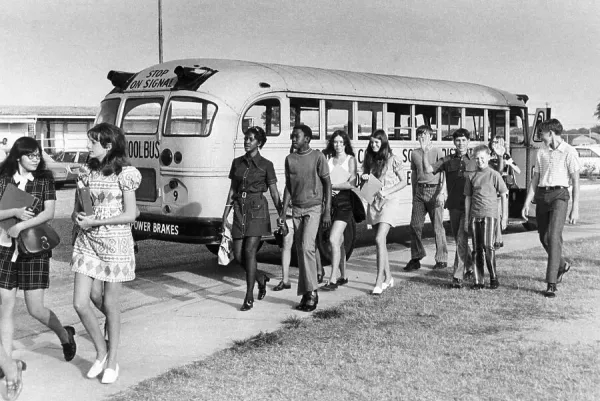
The Bussing: That summer, I remember my mother explaining that Black students would be attending my school, saying, “Well, they want everybody to have a chance to get to know each other,” or something like that. It was simply presented as “the way it was” as we emerged from the tumultuous 1960s.
When the court-ordered buses arrived at Gentian Elementary School on September 7, 1971, I saw no overt hatred or unwelcoming behavior between students or staff. As a child, I didn’t understand racial hatred; it simply wasn’t practiced in my family. For much of my life, I was taught that busing and desegregation of the 1970s were unequivocally positive developments.
But that was only from my own, unaware, one-sided, “white culture perspective.”
The Unintended Consequences: The saying, “the road to hell is paved with good intentions.” The busing in Columbus, Georgia in 1971 was done out of mere compliance with a federal order, not a sincere desire for integration. Among the white community where I lived, there was a public air of acceptance—”Times are changing; this is good.”
Here is the critical detail that many—especially the white people I grew up with—still fail to see: the profound “loss of heritage” and the serious cultural vacuum created within the Black community during this period of desegregation, not just in Columbus, but nationwide.
To meet the 70/30 rule, Black students, and educators were relocated from their established educational environment and thrust into one that ranged from merely different to actively hostile (particularly at the high school level).
Consider the impact on a Black elementary school. These were institutions of culture and community, but many were essentially closed down or repurposed. Along with this demographic change, the history of those schools—the educators, the successful alumni, the sports records—was often erased. Trophies were reportedly thrown away and records compromised.
Desegregation, done through forced busing, created a cultural vacuum and a significant loss of heritage for the Black community. My Black friends have confirmed this observation: forcibly mixing people from distinct cultural environments, even with the goal of equality, will create a vacuum on one side.
Putting the Shoe on the Other Foot: I try to imagine the experience from a different perspective. How would I have felt if I, as a white child, was uprooted and placed into an entirely different cultural environment? I would have been terrified. Even the small moves within my own school—when I was shifted from one classroom to another without explanation to meet the 70/30 ratio—bothered me deeply because I was clueless.
I can only begin to imagine the fear of a Black child on that bus on September 7, 1971, given the history of Black American culture. To be made to go to an unusual place must have been horrifying. Yet, there were many brave children on that bus, and thankfully, at the elementary level, we generally got along well.
They say there are two sides to every coin. In this historical context, the terms “minority” and “majority” were corrupted, and the media, especially in the South, did their best to ignore this cultural vacuum. The forced uprooting alone, regardless of race, would have been traumatizing for any child and parent.

In a national view, entire Black communities suffered as they were forced through a process the white government deemed “good.” The plan focused on mixing people but failed to account for the catastrophic cultural vacuum it would create.
Today, while the context is different, I look at current politicians who denigrate “woke” and Diversity, Equity, and Inclusion (DEI) initiatives. It feels like a return to past attempts to ignore deep sociological realities in American history.
As a white person, I cannot fully comprehend the suffering of Black people in American history because I have not lived it and I recognize that. But, to be “woke” is to see the background reality—the unseen costs, the loss of history, the disruption of culture—instead of just the accepted narrative presented on the surface.
Hoping not to be insensitive; it was very hard to write this, but I felt it was necessary for me.
I’m not a fan of Christmas. I’ve been fighting depression, and I think I’m going to leave it here. I hope everyone has a wonderful Christmas. I hope everyone is having a great Hanukkah, and all the other things that cultures celebrate this time of year.
Go in peace, and may the God as you understand God to be, if any, smile upon you.
Mark
————————————
References and Notes
- ^ Lockett v. Bd. of Educ. of Muscogee County, 111 F.3d 839 (11th Cir. 1997). View Legal Summary
- ^ Causey, Virginia E. “The Long and Winding Road: School Desegregation in Columbus, Georgia, 1963–1997.” The Georgia Historical Quarterly, vol. 85, no. 3, 2001.
- ^ Swann v. Charlotte-Mecklenburg Board of Education, 402 U.S. 1 (1971). Supreme Court Record
- ^ Lockett v. Board of Education of Muscogee County School District, 391 F.2d 272 (5th Cir. 1968).
- ^ “Buses Roll, Schools Open: First Day of Mandatory Busing.” The Columbus Ledger-Enquirer, September 7, 1971. Digital Library of Georgia Archive
- ^ Walker, Vanessa Siddle. Their Highest Potential: An African American School Community in the Segregated South. University of North Carolina Press, 1996.
- ^ Muscogee County School District Desegregation Collection. Columbus State University Archives & Special Collections.
- ^ Thompson, Owen. “School Desegregation and Black Teacher Employment.” National Bureau of Economic Research (NBER), 2019. Research Paper