Coffee Time Blog 14 | Red Ribbon Chokers and Guillotines
The Context: Silence and Survival (1793 – July 1794)
To understand the fashion, you have to understand the fear. During the Reign of Terror, standing out was a death sentence.
In September 1793, the “Law of Suspects” was passed, effectively allowing the arrest of anyone deemed an enemy of the Revolution. The guillotine became the ultimate symbol of state power. Consequently, fashion went into hiding. Ostentatious clothing was dangerous; to survive, people dressed “down,” mimicking the simple, working-class sans-culottes. At this stage, there were no red ribbons. Wearing one during the Terror would have been seen as a counter-revolutionary act—and it would have been fatal.
The Turning Point: Thermidor (July 27–28, 1794)
The atmosphere in Paris shifted overnight during the events of Thermidor.
On July 27 (9 Thermidor), Maximilien Robespierre—the architect of the Terror—was overthrown by the National Convention. The very next day, Robespierre himself faced the guillotine. This marked the abrupt and bloody end of the Reign of Terror.
The aftermath was immediate. Prisons were thrown open, and thousands of suspects—many of them aristocrats and wealthy bourgeoisie—were suddenly released. The city’s mood swung violently from suffocating paranoia to hysterical relief.
The Reaction: A New Wave (Winter 1794 – 1795)
As the shock wore off, a period known as the “Thermidorian Reaction” set in. This winter saw the rise of the Muscadins—young, middle-class men who began roaming the streets. Rejecting the austere dress of the previous year, they used their appearance to signal a new political reality, often physically attacking extreme Jacobins.
It was in this chaotic, reactionary vacuum that the Mode à la victime began to take shape.
The Macabre Ballroom: Dancing with Ghosts
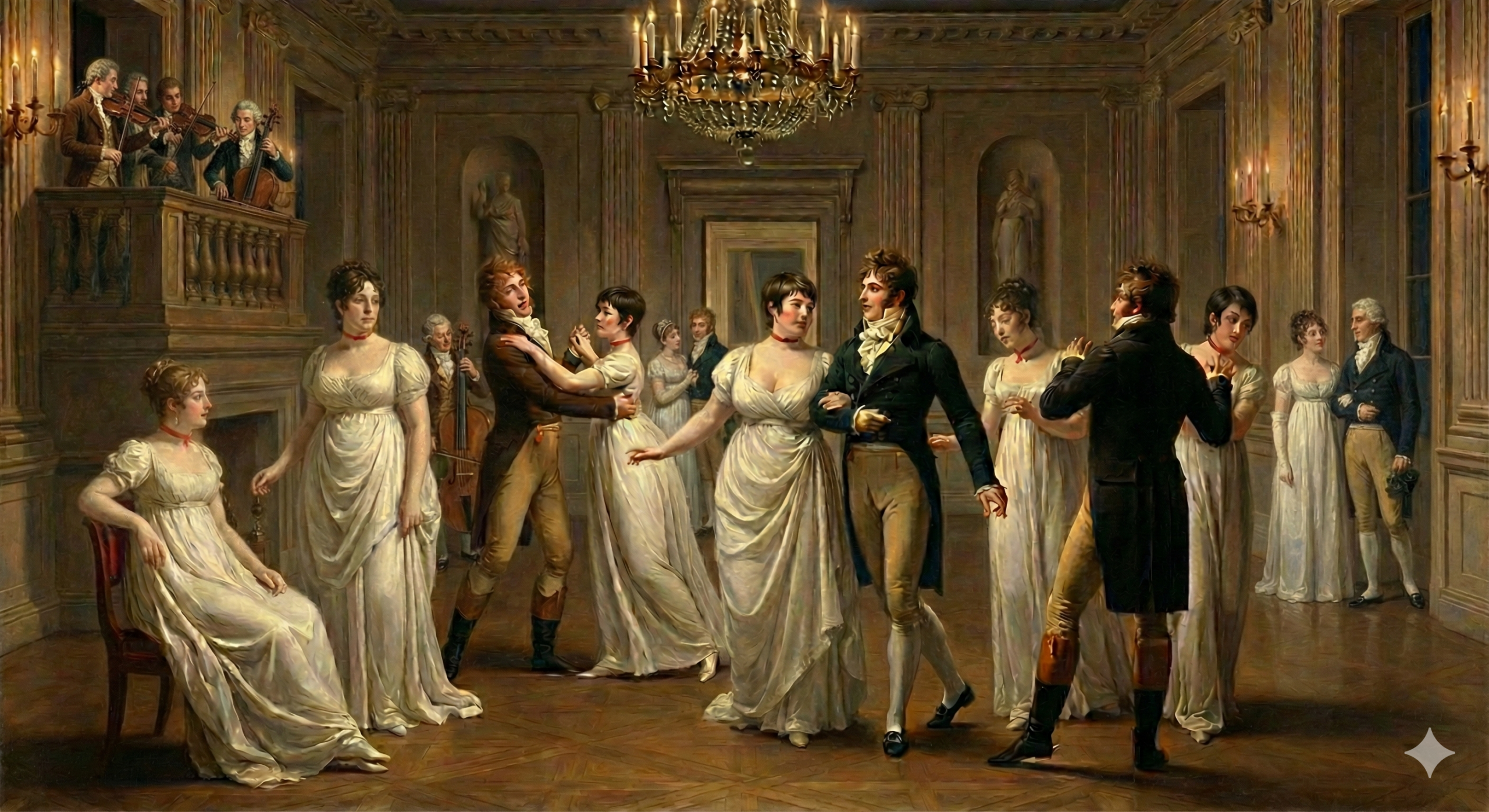
As the reaction took hold, the relief of the survivors morphed into something stranger and darker. It wasn’t enough to simply be alive; the survivors needed to confront the death they had so narrowly escaped. This need for catharsis birthed one of history’s most haunting legends: the Bals des Victimes (Victims’ Balls).
According to accounts from the era, these weren’t ordinary parties. They were exclusive gatherings with a horrific price of admission: to enter, you purportedly had to produce documentation proving that a close relative—a parent, spouse, or sibling—had been guillotined during the Terror.
Inside, the atmosphere was a mix of hysterical gaiety and deep mourning. It was a “dance of death” where the aristocracy, having reclaimed their lives, danced frantically to wash away the memory of the prison cells.
Mode à la Victime: The Fashion of the Condemned
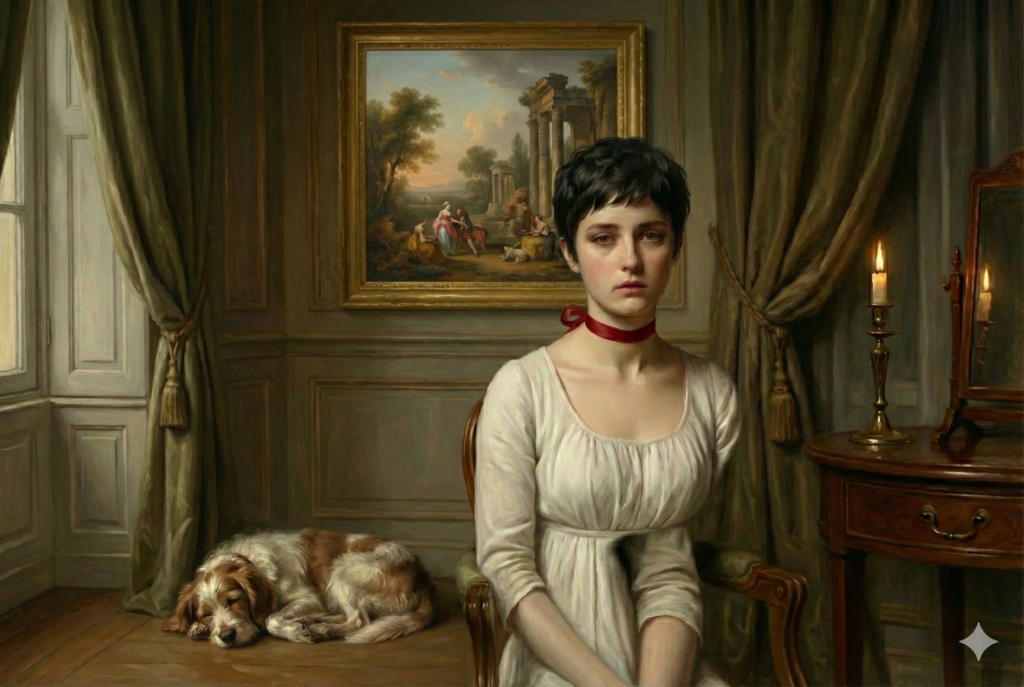
It was at these balls, and on the promenades of Paris, that the fashion trends became truly shocking. They were designed to mimic the final moments of the condemned.
The Red Ribbon
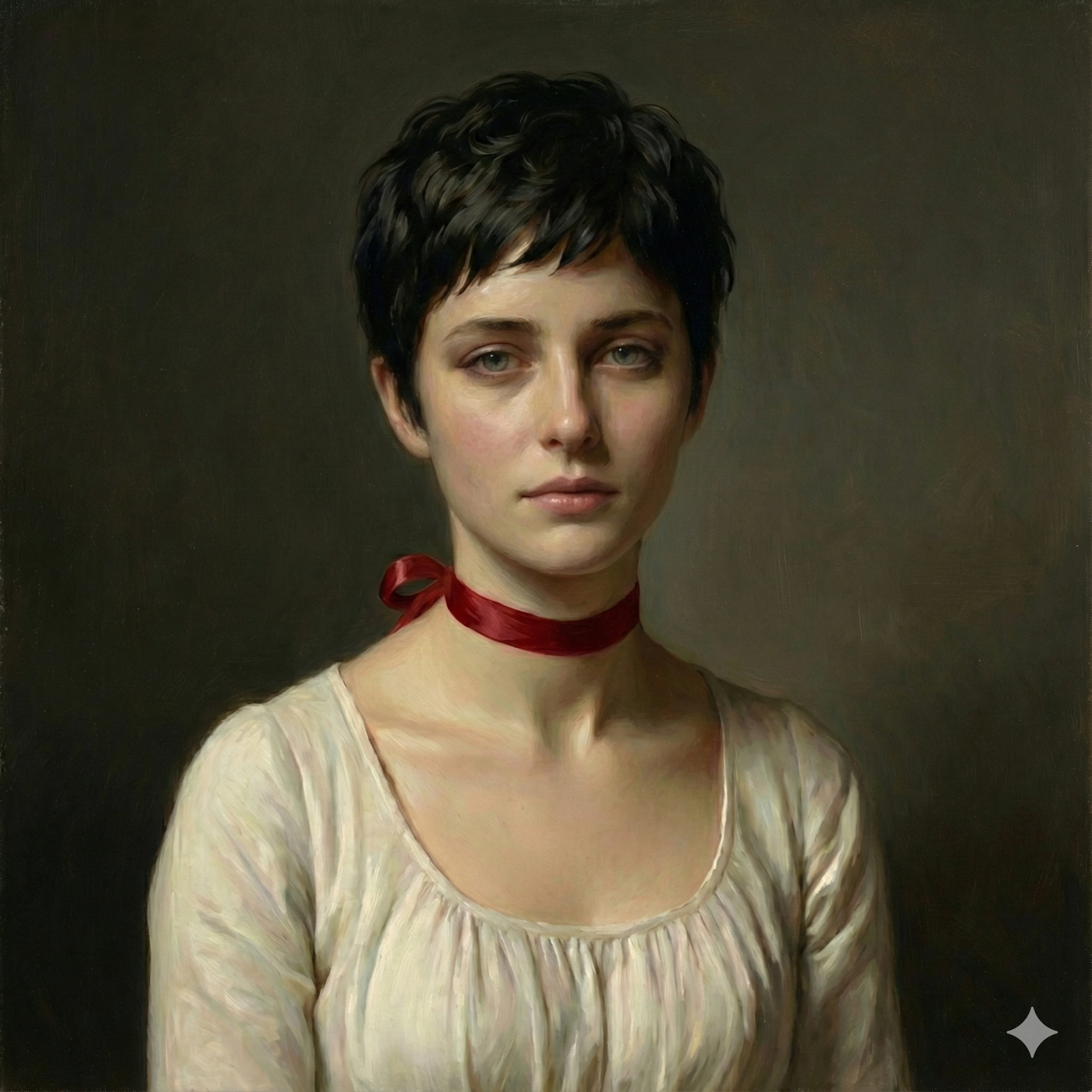
The most enduring symbol of this era was the thin red ribbon worn tightly around the neck. This was not a subtle accessory; it was a graphic representation of the point of impact—the exact line where the guillotine’s blade would have severed the head. By wearing the ribbon, women (known as Merveilleuses) were reclaiming the visual horror of execution. They were taking the mark of the guillotine and turning it into a badge of survival and status.
The “Titus” Cut
The mimicry extended to hairstyles as well. Women and men alike adopted the Coiffure à la victime (also known as the “Titus” cut). Before an execution, the sanson (executioner) would roughly shear the hair off the back of the prisoner’s neck so the blade would encounter no resistance. To honor the dead, the fashionable elite began cutting their hair short and shaggy, often leaving the neck entirely exposed. It was a haircut that said, “I am ready for the block,” worn by those who had survived it.
The “Salut à la Victime”
The commitment to this macabre theater even changed how people greeted one another. Instead of a bow, men would perform a sharp, sudden nod—mimicking the motion of a severed head falling into the basket.
Conclusion: Trauma and the Absurd
In the Victorian Era, the red ribbon choker evolved and eventually became black, sometimes worn with a pendant…a “must have” with alternative fashion today. Looking back, the Mode à la victime seems grotesque, perhaps even disrespectful. Yet, through the lens of modern psychology, it makes perfect sense. We see similar patterns today when people use dark humor or memes to cope with global crises or personal tragedies.
When a society faces collective trauma, the human mind searches for a way to take back control. The survivors of the Terror didn’t ignore their trauma; they wore it. By mimicking the guillotine, they stripped it of its power to terrify them. They took the worst moment of their lives—the fear of the blade—and turned it into a party, a haircut, and a ribbon. It was a declaration that they were still here, still dancing, and no longer afraid.
Happy New Year!
Love,
Mark